Friday, June 22, 2012

Summer is for Veggie Lovers

I'm pretty excited. She's finally here. Summer has arrived. And with her, she has brought, well, a lot of cool stuff, including ducklings (30 of them!), 9 pm dusk, fireflies, sunburns, and swimming instead of showers! But best of all, she has brought broccoli, cauliflower, and a host of other delicious seasonal veggies.

 So far this spring, we have been enjoying loads of greens, including spinach, swiss chard, mangles (new to me!), beet greens, lettuce, mizuna and arugula, as well as the other early season crops like radishes, spring turnips (if you haven't tried them, you should) green onions and kale. There are also plenty of farm fresh eggs, goats milk, home made feta and goat cheese.  It feels really good to rely so little on store bought foods in my day to day life. I probably won't ever be able to give up chocolate or coffee, but there is a sense of gratification and health that comes from eating mostly things that you planted yourself, or at least from animals who you helped milk, feed, or collected eggs from.

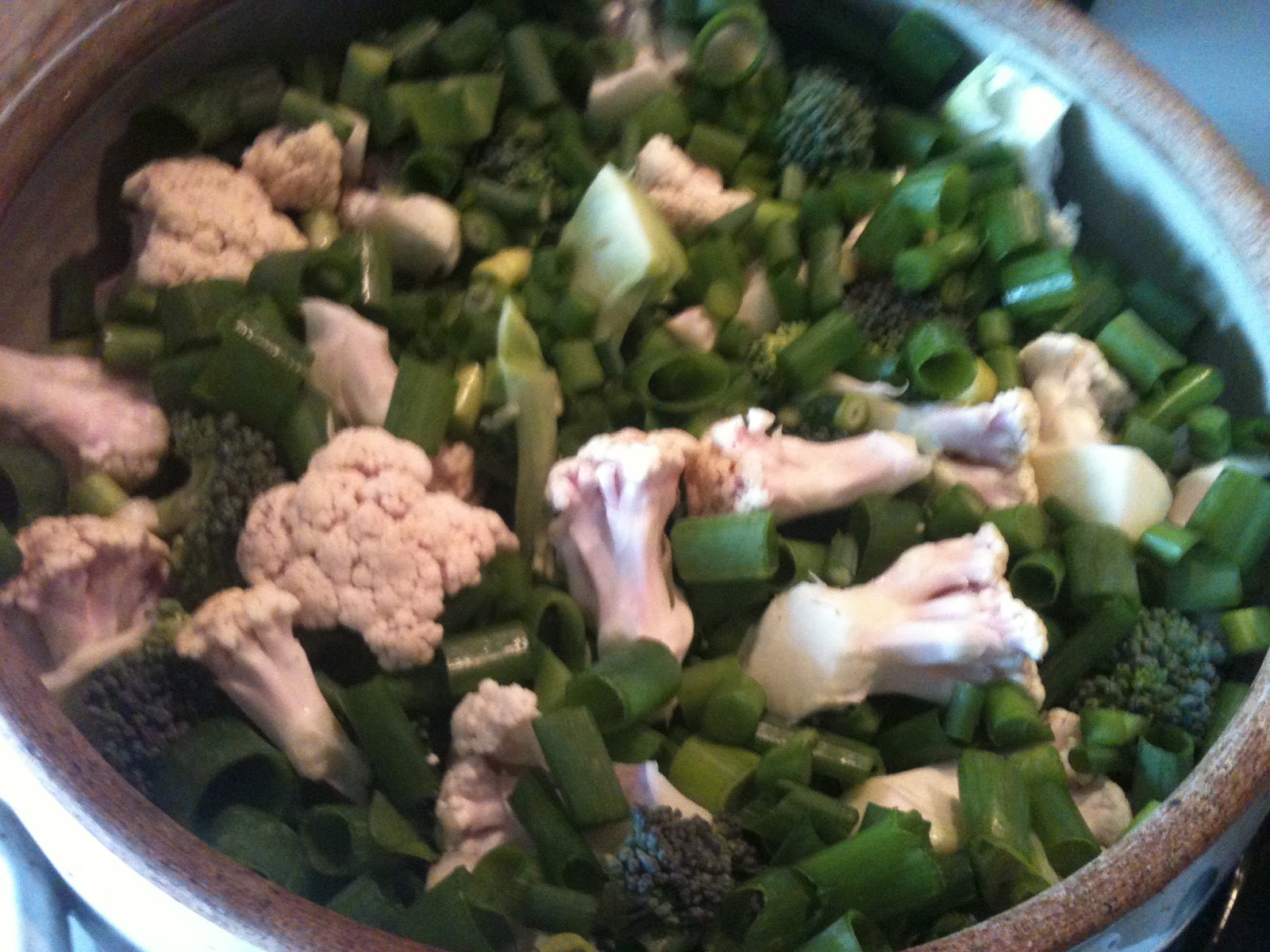
As a result of this, my cooking has been extremely local of late, but I've been having trouble keeping ahead of all of my farming tasks and still retaining enough energy to write a blog post. Today's dinner, however, made me realize that it's good to take a break for something you love, sometimes. And if there is one thing I love, it is Broccoli, Cauliflower & Cheese Casserole.

I've been using different recipes for years, and there are endless variations, but today I was feeling adventurous and decided to try making up the recipe myself. This is more or less what I came up with. I was trying to keep it traditional, but if you know me at all, you know that I would be quick to add some spice to this any time. Curry, paprika, or italian seasonings like basil and oregano come to mind.

This is a recipe that reminds me of my family, and of home.

Sauce:

2 tbsp butter
2 tbsp unbleached flour
1 1/2 cups milk
3/4 cup grated old cheddar cheese
salt and pepper

This is a basic cheese sauce. Make the roux by melting butter in a saucepan, then add the flour and cook, stirring, until brown, about 2 minutes. Add the milk and heat, stirring often, until the sauce thickens. Add cheese and salt & pepper to taste, and remove from heat.

1 cup broccoli
1 cup cauliflower
handful of green onions
handful of green garlic
3/4 cup grated old cheddar cheese
1 cup bread crumbs

Arrange the broccoli and cauliflower evenly in the bottom of a medium sized casserole dish. Sprinkle the green onions and garlic on top. Pour the cheese sauce over the veggies, then cover evenly with cheese, and top with bread crumbs. Bake at 350° F for about 30 minutes or until cauliflower is cooked but still firm (broccoli cooks faster and will be done first).

Saturday, May 12, 2012

Looking Up

HighLand Farm. Photo by a previous intern.
Today an old friend and I were walking through a pasture in the late morning, talking about our lives. We had just hiked a big hill at the back of the farm I am staying on-- a hill that leads down to a tidal river that leads out to the sea. By the time we reached the top of the hill we were pretty tired... we were hunched over, looking at our feet, trudging, and looking forward to when the walking would get a bit easier.

Once we crested the hill, I was able to focus more on the beauty of our surroundings. I love the way that the new leaves bring a green glow to the treetops in spring. I love the wind playing in my hair, the smell of springtime in the air, and the fact that I got to enjoy the day with one of my oldest friends in the world. I looked at those beautiful trees and exclaimed, "I just love that wash of green that you see in the tops of the trees this time of year!"

Tulip. HighLand Farm, Photo by Sarah Ferguson.
She knew exactly what I meant. It's like how I'm always telling people that turning on the tap and getting hot water is actually a crazy miracle. And how fascinating those little things that we take for granted can actually be. My friend frames these beautiful things with her camera, or crafts them with her hands, or learns everything about them so that she can hold them and their immaculate beauty in her mind forever. We can easily reflect on all of the wonder that life holds. We both understand that. It's important to us.

I've been thinking about it a lot lately: all of the beauty that life holds. I thought about it this morning when the sun shone in my window at dawn, and I think about it when I'm planting beautiful, healthy, delicious food every day. I thought about it today when asked who my best friends were. I could list them on one hand, starting with my sisters. And thought about it when I bought a book at the used book store this afternoon and started reading it, only to get distracted by an email from a friend who had purchased the exact same book today, and was writing to tell me about it. Amazingly, a major topic of this book is that coincidences aren't really coincidence at all. They are synchronicities. This Universe is full of them. It's lovely.

Me, Charlie and Scott, on HighLand Farm.
Photo by Sarah Ferguson.
My sister, and my friends, and my host here on the farm, we've all discussed it and we agree: there is so much beauty all around us. All we have to do is look up and see it. The people you meet or reconnect with have a purpose for you. They can show you something you didn't see. The friend who calls just when you were thinking about them has a message. You should listen. The song you haven't heard in years, the smell of lilacs in June, the question you asked in your head that got answered secondhand via your sister by an old teacher you haven't seen in years, and the guess you made that turned out to be true: it's all part of the miracle. You just have to look for it.

Grashopper in an onion blossom. HighLand Farm.
Photo by Sarah Ferguson.
Look up. See what's happening around you. Drop what you are doing. Stop thinking about your car, your mortgage, your drama, your job, your regrets. Stop worrying what people think about you. Stop hating what you can't change about them. Just stop. Change the way you think. Next time you have a choice, choose joy. Choose appreciation. Cut someone some slack. Accept that they are who they are, just as you are who you are, and that there is inherent beauty in it just the way it is. Allow your friends and family to have flaws, and believe that those flaws can teach you something valuable. Accept that you are right where you need to be doing exactly what you need to do.

Look up at the sun or the moon or the sky, and see infinity. This is what you are. We are part of the infinite wilderness, and it is infinite inside of us, and we can't change it or control it. We can only accept it and play our little part. And that's beautiful.

Your life will have its hills, and whether you like it or not, you will have to climb them. You can look down at your feet and be resigned to your fate, or you can look up and see the beauty of the journey. To me, the choice is simple. I hope you find yourself looking up too. 

Friday, April 13, 2012

The Real Food Diet

Okay, so I have become a little distracted from my "concoctions" posts. But they aren't cancelled, just delayed... and for good reason.

Reason the first? I moved to an organic veggie farm in Nova Scotia! Reason the second? Because I realized that it will probably make more sense to make yogurt from a goat I milked myself, fermented veggies from veggies I grew myself, and do a blog about a sourdough experiment that actually worked.

In case you haven't guessed, the farm I am on has goats for milking. The kids are really cute, and there are more soon to come-- one momma is about to pop! So I plan to make yogurt from some of the milk, because according to some of the reading I have been doing recently, raw milk products are incredibly good for you: way better than pasteurized. Additionally, some of the most important nutrients that we can get from food are found in animal fats and products like eggs and butter that come from animals who live more like they would in nature. So, chickens and ducks should be allowed to forage and eat bugs and worms, and goats and cows should graze and eat grass like they were meant to do. This allows them to create the most nutritious milk, eggs, and meat. There are nutrients in these foods in the correct ratios that can't be found anywhere else (e.g. Omega 3 fatty acids), and when left raw, these foods also include all of the necessary digestive enzymes that allow you to digest the food properly and completely.

But don't get me wrong: I still looooove my veggies! That's why eating locally matters so much. Vegetables that are in season, fresh, and grown organically using sustainable methods are so much better for you. Mass-produced food is grown using methods that only serve to make the vegetables look pretty and keep fresh for long periods of time (so they can be trucked to a far-away supermarket). Organic veggies grown in small-scale operations are grown using methods that feed not just the plants themselves, but the soil's ecosystem, which produces healthier, more nutritionally complete food.

The point here is that the healthiest way to eat is to eat whole foods. Real foods. Not foods that require an ingredients list a mile long, or that include words we can't pronounce.

According to the same author, the true evil of the modern diet, and the thing that causes most modern ailments such as heart disease, auto-immune issues, cancers, and degenerative illness like Alzheimers is actually sugar. Go figure.

This is a mind blowing revelation for me, but it is one that really makes sense. After all, humanity survived for thousands of years living on these animal products, without sugar. And it is only since we have started to eat it at every meal, and with almost every food or drink, that we have noticed the prevalence of all of these diseases.

Of course, as with anything, I think it is important to take this information with a grain of salt (not sugar!). Obviously, a little bit of sugar once in a while isn't going to kill us. But the less sugar we eat, the better. So, in addition to trying as hard as I can to eat only real foods that are, wherever possible, produced on the farm, close to home, or a the very least, organically, I am also going to try to greatly reduce my intake of sugars and refined carbohydrates (refined carbs turn to sugar once they are digested). In other words, I'm focusing on real food.

So far, I feel great, but that might also be attributable to the fact that I have been spending every day doing physical work, outdoors, in the fresh air. I'll keep you posted on the results, though. And more to come soon on my other farming adventures :)

---

If you're interested in more information on the specific reading I have been doing, check out the Weston A. Price Foundation, as well as the campaign for real milk. The Real Food Diet is a real thing, too, apparently... according to Oprah, anyway. 

Thursday, March 29, 2012

Homemade Yogurt

My first attempt at making yogurt was a big fail. I chose to blindly trust the booklet that came with my dehydrator, and promptly wasted a litre of delicious organic milk. Turns out 1986 was still figuring out homemade yogurt!

This time, I am home on the farm, so ironically, I don't have access to organic milk (the sheep are just starting to lamb, and none of the small town grocery stores sell organic milk). Luckily, regular old milk in a bag works just as well, even if it is not organic.
Instead of buying a container of plain yogurt solely for the purpose of making more yogurt, I purchased some yogurt cultures in a small packet from our local health food store. This worked really well.

Now that I've tried it, I think homemade yogurt is like homemade bread--  easier than you'd think.

Here's what you need:

1 or 2 litres of milk
1 packet of yogurt cultures OR
a few tablespoons of yogurt with active bacterial cultures

a big stainless pot (heavier is better so as not to burn the milk)
an large bowl or insulated container
a thermometer
a heating pad or blanket


Step One:
Heat the milk slowly in the large pot, stirring frequently, until it reaches a temperature of roughly 185 degrees Fahrenheit. You may want to use a double boiler if you are concerned about scalding the milk.

Step Two: 
Remove the milk from the heat immediately and let it cool to about 110 degrees. Add your yogurt starter or active yogurt and stir well. It's important not to do this until the milk is cooled or the bacteria will be killed by the heat!

Step Three:
Move your yogurt-in-progress to the insulated container, cover with a lid or towel, and keep warm for 8 hours. You can do this by sitting it on a heating pad or blanket set to medium heat, and/or by storing in a well insulated container such as a large thermos (depending on your thermos, this may still require a heat source). I chose to store my yogurt in a big glass jar wrapped in a heating blanket and placed inside a cooler bag, which was pretty successful.

Step Four: 
Wait 5 to 7 hours, and check it out!
If your yogurt is ready, give it a good stir and then store in a sealed container in the fridge. If you would like a thicker yogurt, leave it for a few hours more. It will thicken a little bit as it cools and should last in the fridge for at least two weeks.

A few notes:

Your yogurt might be different than store-bought yogurt for few reasons. If your yogurt is slightly chunky, don't be concerned. Most store-bought yogurt is 'stirred,' and they don't mean with big ole spoon! Also, yogurt products often contain gelatin, corn starch, or pectin to create a consistent texture. If you love this, you can always add these things to your own yogurt.

Your homemade yogurt may also be more tart than you are accustomed to. This is the natural flavour of yogurt, whereas yogurt manufacturers often use additives to control that tartness. Adding a natural sweetener like honey or maple syrup should contrast the flavour nicely.

Finally, there is whey. Whey is the liquid that gathers on top of yogurt as it "cooks."  Don't dump it out! Stir it in to your yogurt: the whey contains most of the healthy bacteria as well as calcium, and other nutrients you don't want to lose. In fact, Little Miss Muffet was most likely enjoying a delicious bowl of yogurt in the old nursery rhyme. Be like Miss Muffet. Whey to go!


Sunday, March 11, 2012

Concoctions

When I was a little girl, I liked to make "concoctions." There was nothing I enjoyed more than putting together various strange ingredients in some magical combination to create something new and different. Whether it was a food, home remedy or beauty product, or even simply make-believe, the idea of brewing up a potion could always get my mind racing. Still does!

I enjoyed it so much that a lot of my concoctions became vivid childhood memories. We had a children's book by David Suzuki-- I think it was about human anatomy-- that for some reason had a recipe for eggnog in it. I remember being thrilled that I could make eggnog by myself. It was easy! And it didn't come in a carton! I used a manual egg beater. The kind you hold with one hand and spin with the other. And I am pretty sure this was my first experience using nutmeg. I love that I can remember that, when half the time I can't even remember where I left my boots!

Over the years, I also put a lot of weird things on my face and skin. There were oatmeal masks, milk baths, and egg and salt foot scrubs: on those days everyone in my family would get a foot massage, except maybe my Dad, whose feet I wasn't willing to make contact with. I had a desire to heal the body with homemade ingredients: I would scour the books we had for home remedies. Thank you, Reader's Digest.

More often than not, there was an element of play in my creations. Concoctions were an outlet for creativity, one which I shared with my sister. I'll never forget the day we decided to make a game of creating different appetizers for each other. It started out innocently enough, but quickly became a competition to see who would do a better job of tricking the other into eating something really weird disguised as something delicious! I think the kicker was a dessert-like creation with peanut butter and graham crackers and marshmallows-- with a surprise dob of horseradish in the middle! Thanks, Brooke.

As a teenager, I got into aromatherapy. Lavender and cedarwood for relaxation, orange for energy, mint for health. I would take baths with essential oils, and burn them in my room. Strange smells would spill out into the hallway, but my family never complained. The smell of cedar still throws me back to those days.

I wanted to be a herbalist before I really even knew what a herbalist was. I was thrilled when I realized that there was an endless supply of mint growing in our yard! I also wanted to be a witch. Not the wart-nosed cackling kind, but the earth-mother, pagan ritual kind. Witches know things about the earth. They have the secrets. I wanted to find those secrets, learn how to make potions, and live outside in the woods with the trees and the wildflowers and the wind. I still do. But I'm not about to make any blood sacrifices-- and I'm pretty sure that eye of newt would not legitimately help with any type of ailment. And cauldrons are pretty pricey, so I'll have to settle for a rocket stove or something!

As I grow older, I have come to understand that concoctions were a learning tool, as well as a creative outlet. Through my experimentation, I learned a lot about the natural world, as well as the food we eat. I love how food is our connection to the elements of life: the sun, and the rain and the earth and the wind. There is magic in those elements. It's all connected, and it's all beyond our understanding, no matter how much wisdom we collect, and no matter how much we think we know. We really know nothing at all. It's painful and beautiful at the same time.

But what we do know is still valuable! And I still love my concoctions.

Which is why, when I was recently introduced to the magic of fermentation, I went a little crazy in the head.

It's not that I wasn't already aware or interested in some of these things, I just didn't realize how good they were for you, and I hadn't taken the time to explore the topic in its entirety. Now that I am learning more, I'm getting pretty excited about it.

I've decided to share with you, in installments, my experiments with growing 4 different kinds of cultures, yeasts, and ferments: yogurt, kombucha, sourdough starter, and fermented vegetables (aka sauerkraut).

In case you are skeptical, or are wondering what is so great about these things, I would suggest that you start by visiting this web site, which is a really good source of information regarding the health benefits of fermented food (thank you, Jake, for sharing this web site as well as your enthusiasm!).

Stay tuned for the first installment: homemade yogurt.

Friday, March 2, 2012

The Cost of Everything

Today I drove home from my last day of my 9 to 5 job, thinking about how everything costs something.

When I was in University, I didn't like how long it would take me to get places by foot, bike or bus. I often felt like I was wasting my time, getting from place to place. Now that I have a car, and a monthly insurance payment, and a gas tank to fill every week or two, I realize that the alternative is wasteful in a different way. And it occurs to me that this is true of all expenses: in fact, it is probably true of every action we take, every single day. There is a cost associated with almost any action. I am sure there is some theory in Physics or Economics that accounts for this, but I am not a physicist or economist, so I'm just going to give you my personal take on the matter.

Everything is made of energy. Everything you do (or think, or say) uses your body's energy. This is why you have to sleep every night. This is also why you have to eat food. And, it's why you feel like you have no energy in the winter time: all of our energy ultimately comes from the sun. Our existence is dependent on the sun, whether we like it or not. And in the winter, we see a lot less of her.

Me, driving.
Going places uses your body's energy. But if you are rich/lucky enough to live somewhere where it is an option, you can trade your time and effort in to have that energy in a different form: you can work 9 to 5, and put your energy into your job, to get money, with which you can then purchase something (a car, or a bike) that will allow you to use less energy to get where you want to go.

But in order to do this, you must be chained to a desk every day.

I used to think that having a car would give me freedom. In fact, when I mention to people that I often think of selling my car, that is the usual response I get: oh no, don't do that, you'll lose your freedom and independence! And since I still have my car, I guess that means I tend to agree with them to some extent. But here's the thing: if having a car means I have to work a job that doesn't truly make me happy, am I really that free and independent? Am I not actually even more dependent than I was before? I am dependent on my job to provide me with the money to pay my car insurance and put gas in my car. I am not free to do the things I would like to do with my time, because I am spending my time working to pay for my "freedom."

Huh?

Do you really want to be these people?
Perhaps if I was doing something that I truly loved doing, that gave me pleasure and joy and passion and emotional energy, it would be reasonable to do this. But I have not yet found a way to make a living of those things (I'm working on it!), and I don't think it is reasonable to work a job that doesn't make me happy simply for the purpose of being able to... drive around.

I have concluded that if I did not have a car, I would actually have a lot more energy. I would get more exercise getting myself places, and everyone knows that exercise gives you energy. I would be healthier. I would know the true cost (in time and energy) of getting places, so I wouldn't jam my life full of things to do, and I would have more time to stop and think, do yoga, meditate, and just be. And best of all, I wouldn't be relying on an unsustainable resource to get me from place to place at high speeds. I have a funny feeling that all of this speed is going to cost us a lot more than we realize, somewhere down the line.

My neighbourhood (sort of): Rideau Canal at night.
Walking and biking are so much more enjoyable than driving. No matter where you live, you don't truly know your neighbourhood until you have walked it. If your goal is to truly be wherever you are, travel at any speed becomes enjoyable-- an act of exploring and living within the geography you inhabit, rather than madly dashing from one location to another, "getting things done."

Similarly, I believe that if I take pleasure in growing my own food, it's silly to work a job so that I can eat. So much energy goes into producing and transporting food! This seems so wasteful to me. Why are other people working to make my food, when working to make my own is the very thing that brings me the greatest joy?

With every move I make, I want to become more connected to the earth-- and I can do so by slowing down, sowing seeds, and savouring every moment of the day. For me, this is what it truly means to be free.

Tuesday, February 28, 2012

For the Love of Drudgery!

I cancelled my cel phone bill and the cancellation kicked in today. At first I was worried I would go through withdrawal, and I am sure there will be times where I wish my phone still worked, but so far I feel liberated. I just called a real person to make plans with them, for the first time in a very long time. As I spoke, leaving a message on their machine, I realized I was feeling relieved. Even though I was talking to a machine.

Turns out, human connections are healthy, for more than one reason. We need each other, as much as we need to sleep or breathe or eat. When we don't speak to each other, we create walls. Human connections can be made in lots of ways, and I am certain that hearing each other's voices is one of them. So is touch. Consider the words of Alan Muskat, from his article, No Taste Like Home:

Struggling to keep up with the March of Progress, we also leave each other behind. We've invented machines to do work that our mind considers tedious, like processing wild food, weaving, and washing clothes. We call it drudgery, and women fought hard to be liberated from it. But what makes drudgery dull is isolation. This kind of work is meant to be shared, and it's just the sort of mindless activity people can do while hanging out, catching up, and really getting to know each other. I believe the loss of drudgery has unwoven the fabric of society. From TV to computers, our interactions with the world and with each other have become mediated; that's why it's called "media." We've gone from face look to Facebook. What we've supposedly gained in time — again, only to spend it working for The Man — we've lost in community. Divide and be conquered.

I'm excited about taking steps toward living a life where I can connect with people in a more real way. And I'm glad that I have an excuse to call instead of texting. Or to stop by someone's house without calling first: if I don't have a cel phone and I'm just happening by, how would I be able to call ahead? Spontaneous connections are important, I feel. 

So are physical connections. I recently read about how human touch is not only a stress-reliever, but in fact, it has healing power. As soon as you think about this, you think, of course! It makes sense. There is a reason my sister says her massage therapist is as much a therapist as she is a massage therapist. And it's probably not just about the fact that she is easy to talk to. The people who we feel comfortable touching are the people who we feel comfortable being ourselves with. 

I knew Charlotte Diamond had the right idea!

Now, everyone go hug someone they love.