Monday, October 29, 2012

Tiny House

I want a tiny house.

Now that I am home from Nova Scotia, it's time to look forward. I'm living at my parents' place, looking for a job (the one I came home early for didn't exactly work out), and thinking about how I am going to move forward with this way of life I have chosen.

It dawned on me some time ago that as a single, underemployed woman with no conventional "career" in the works (not true-- I'm a farmer, dammit!), I was going to have to be creative if I ever wanted a place of my own. Of course, I have an obvious advantage over those other budding organic farmers out there: I grew up on a farm. And I have a Dad who really wouldn't mind having someone to talk about farm stuff with. And he's willing to share the land.

So for months now, we have been discussing how this is all going to pan out. And we are far from figuring it out. But I realized that paying rent to have a job in the city doesn't make a whole lot of sense, if where I want to be is in the country, establishing my farm. So here I am.

So far, I have planted a lot of garlic, and that's about it. I've got plans to plant trees, dig a pond for irrigation, put up a greenhouse, and get a really rad compost going... but I'm also really preoccupied with getting out of my parents' house. Do you blame me? I love my parents a lot, obviously, or I wouldn't be where I'm at right now. But realistically, I need my space. Not a lot of space, but my own space nonetheless. And that's where the Tiny House comes in.

First, I was thinking I would build a cute little log cabin from logs cut on our property. Then, I thought I could experiment with cobb building and have a house made of mud! Then I realized I didn't have enough experience to do that myself, and I need to take help where I can get it-- I can get more help building something conventional than I can building something like this (but I am not ruling out doing mud plaster at some point!). Lately, I've come to the realization that I really don't want to have to go through the process of getting a building permit, largely because of the ridiculous cost, but also because the bigger your house is, the more money it costs to maintain it. And let's face it: I want to be a vegetable farmer. I'm never going to have a whole lot of money.

So, I need a teeny tiny house. Preferably on wheels, so it can be bigger than 100 square feet, which is the maximum size a building can be without a building permit. Trailers, however, do not need to be permitted. That's where the Tiny House people come in.

I heard about Tumbleweed Homes from some friends I know who are building a little off-grid cabin in the woods as a cottage/camp/recreation spot. A home away from home, but a really cosy home indeed! I am really inspired by what these people are doing, and I'm getting really excited for what I might be able to do. If I can source out as many used materials as possible, I might be able to build myself a home for really cheap! It would have a composting toilet (or maybe just an outhouse and outdoor shower), a sleeping loft, a cosy little living room, and an itty bitty kitchen. Plus, I can add screened in porches and other outdoor living spaces to make it feel bigger. Check out the web site-- it's really exciting! If all of this works out, I might have to start blogging about cooking in a teeny tiny kitchen.

So now I have to figure out about building materials. The logs from our property idea is the most environmentally friendly choice, but the problem there is that they need to sit a year after being cut. I'd like to build next summer. I could do cordwood (aka stackwood or stackwall), but I really don't know the first thing about it, except that it is pretty, and doesn't seem too difficult! I would consider buying the pre-cut logs from Chisholm's, but I would really rather not buy logs when I have them here. Especially since I'm not planning on needing a permit. And I want to do something that won't require insulation, because that can be costly and will take up my already limited space.

Does anyone have any suggestions, experience, or ideas with cordwood construction or building tiny houses? Know anyone who does workshops and needs a project to teach on? I am totally open to ideas and input... please let me know what you think.


Wednesday, October 17, 2012

Gills

Sometimes I write poetry. Sometimes it's good! And most of the time it's not really meant for sharing. 

Today I spent some time unpacking and sorting out my belongings. I don't know about anyone else, but I have a bad habit of stuffing the little pieces of paper on which I write poems, quotes, lists, reminders or inspiring thoughts into random places. Later, I find them in purse pockets, change purses, jacket pockets, inside books, dresser drawers, at the bottom of an overnight bag, and in a host of other places. It's become a habit I enjoy-- a gift to my future self. I find my own thoughts again later on, and sometimes they bring me full circle, to an important realization, and other times they help me recall moments and memories I didn't realize I hadn't thought about in a while. 

I've been carrying this poem around since last fall, and every time I find it and read it I think I like it more. It's not deeply insightful or life-changing, but it reflects where I was, mentally, at the time. 

You are not young. 
You never were.
You are not young:
You're as old as these hills, 
As the ocean you crawled from
When you still had your gills.
You are not young, 
But you're learning.

You are not old. 
You'll never be.
You are not ancient:
You're as new as this moment
As the burn of the sun
And the pulse of the tide.
You are not old,
But you're still yearning. 

~


Sunday, September 2, 2012

Power


"When born we weep, while others round us smile.
May we live that when we die
We smile, and others round us weep."

- The Good Book: A Secular Bible by A.C. Grayling


I have been touching people. I have been rubbing up against them. We have been creating friction between our skins. And the friction builds heat inside of me. And with that energy, I can create. And with everything I create, I touch more people. And the more people I touch, the more they touch me back. And we begin again.

All my actions have reactions. All the people that I touch, touch me back. All the touch transfers energy.

I feel alive.

With everything we do, everything and everyone we touch, we are engaging in energy transfers. Every action empowers something or someone. Have you thought about what you are empowering with your energy? Is it a worthwhile things to give your power to?

An example of how plants feed me!
Here on the farm, I spend a lot of time and energy encouraging food to grow. I use my energy to help the plants get energy, and in return those plants feed us with more energy.

Some days, I stop in the middle of a row of beans, take a deep breath, and pause for a moment to notice myself actively expressing my own concept of my life's purpose: to share my energy through growing and creating food. I notice the crickets and the grashoppers singing, the roosters crowing, and the sun, wherever she is at in the sky at that moment. We are all rejoicing in that moment. We have power! Love! Energy! I see how we are all part of this continual exchange, this network of life. And I appreciate my place within it.

This weekend I was reminded that energy is not just physical. Emotional and shared creative energy are extremely valuable, in ways I think economists and analysts and physicists perhaps don't give due consideration.

How can you make a calculation for how it feels when the music is so inspiring you just can't help but get up and dance? What equation expresses the energy that is transferred when people you just met make it their mission to warm you up with hugs? How can you express what power you share when you sing to people, and they listen, and they keep listening-- for months, weeks, years?

Music is powerful. Touch is powerful. Creation is powerful. But there is no way to prove this through science, and if there is, I don't really need it. The proof is in the way I feel.

I feel alive. More alive than I feel when I shut myself off, for fear of being alone in a crowd. You don't stay alone for long. People crave touch, and you can touch them. Touch them with your hands, your words, your music. It doesn't matter. Just take your love, your music, your power, and roll it into a big sweet ball of beauty, and throw it at someone. Splat! Like a snowball to the back of the head, right when you least expect it. And see what happens.

I bet you'll be pleased. Pleasantly surprised, even. If you're lucky, you'll hit the person who needs it at just that moment, and it'll open up a door. If not, you'll still have touched them. And whether you know it or not, your touch will change them. Maybe enough to redirect their course. Maybe enough to empower them to touch someone else, too.

With everything you do, you change the world.

Saturday, August 11, 2012

The Other April

I've learned a lot of interesting and  life-changing things while being here at HighLand Farm. Some things I expected to learn, and other things I didn't. I know more than I ever thought I would about how (or how not) to care for Muscovy ducks, for example. I have a much more thorough understanding of the complexities of plant life and how it operates within the farm ecosystem. I've learned how to use some really good hand tools that liberate me from the need to use gas-powered ones, and I've developed a sense of the rhythm of the tide, and how it affects me. I've learned about Tibetan Buddhism, Shambhala, and I've developed an awareness practice that is changing how I interact with the world and its people and animals and plants and seasons.

All of these things, and many more, will change the course of my life forever. And I think it's great. It's everything I was hoping for and more.

One of the most enjoyable practical things I have learned is how to milk goats and make goat cheese, feta, and yogurt. Today, for the first time, I milked by myself and actually milked both goats out before they started kicking up a fuss. This is an accomplishment for a few reasons: 1) because until now my hands weren't strong enough to milk fast enough to finish before the goats finished their grain, 2) because even if my hands were strong enough, I wouldn't have known until now because usually I have company, so we take turns, and 3) because doing something like this on your own without help is a pretty liberating feeling.

Another reason the experience of milking on my own is so enjoyable is because I genuinely enjoy the goats. They have personalities-- calming spirits. They are really nice animals to be around. Just like a lot of people find that there is a therapeutic quality to being around horses, I enjoy being with goats. They speak to me. They understand. Interestingly enough, I am a Capricorn-- a goat. Go figure.

My favourite goat is April. I don't know why. It could be her long beard or her easy-to-milk teats, or it could be something else entirely. Probably the way she looks me in the eye when she stands up on the stall door and says, "Um, hello!! Where is my grain?"

So in celebration of April, and Bonnie, and Jumper too, I am going to tell you how we go about making some delicious raw goats milk cheeses here on the farm.

How to make Soft Goat Cheese and Goat's Milk Feta

1) Milk the goats. If you don't have this option, look for a source of raw milk in your area. It's not legal to sell it in most provinces, so you might want to offer a trade of some sort. If all else fails, organic pasteurized goat's milk from the farmer's market or a local farm will do!

2) In a really clean vessel mix goats milk and about one drop of rennet per litre. You can also add some active bacterial cultures to enhance that classic chevre flavour, but you will need to do some research here first-- this is a specific type of bacteria that might be hard to find. Some health food stores or local dairies might have either or both of these ingredients, or you can have your ingredients shipped to you from somewhere far away (e.g. Cultures for Health) . If you are a vegetarian, you will also have to find a source of non-animal rennet.

(Alternatively, it is possible to curdle the milk using lemon juice or vinegar, and make soft cheese that way. There are lots of web sites with instructions on how to do this, but the recipe requires heating the milk, which I don't want to do because then it won't be raw anymore. So animal rennet is fine with me!)

Once you add the rennet and bacteria, stir the milk really well with a very clean spoon, cover well, and leave for 24 hours.

3) When the milk has curdled the way it should, your cheese will resemble yogurt that has settled in its container. The yellowish liquid on top is whey, and it is really good for you! Now you need to strain off the whey and press the curds to get all of the whey off of them. You can do this is various ways. We use two yogurt or ice cream tubs, one with holes poked in it and one without. The holey one is placed in a bowl (to catch the whey) and the other one is used to press down the curds so that the whey drains out of the holes. Another method is to use a strainer and several layers of cheesecloth. Simply pour off as much whey as possible, and then transfer the cheese into the lined strainer to let it drain. For this method, you will need to find something the same size as the strainer to press it with.

You'll have a lot of whey. Keep some for making brine, if you plan to make feta. If you can, use it to soak dried beans, or add it to another recipe. Alternatively, you can cool it in the fridge and drink it. I'm not a fan, but some people love it. If you like buttermilk, you might like whey.

4) Leave the curds to drain without pressing for a day or so (keeping them covered to keep out airborne bacteria), and then start pressing. We usually fill the upper container with water to help press out more liquid, and we make a point of pushing on it a few times to squeeze out a bit more water. The amount of moisture will determine the texture of your cheese-- more liquid means a softer cheese, and less means more crumbly or firm, depending on how you store it.

5) Once you feel your cheese is dry enough, the next step depends on what you want your finished product to be.

Goat's Milk Feta: Try to get the cheese quite dry by pressing out a lot of the whey. Then, transfer your cheese to a salt brine, and make sure the cheese is entirely covered in brine with no exposure to air. Store in an airtight container in a cool place (the cellar or the fridge) for at least a week.

The amount of salt in your brine is up to you, but generally a 10 to 15% salt solution is recommended. Try about 1/3 cup of salt to 2 cups liquid, and then experiment to see what you prefer. You can make your brine using salt and water, or salt and some of the reserved whey.

Soft Goat Cheese: Don't worry about getting the cheese quite as dry-- you may not even need to press it. When you feel that it is the texture you want, transfer it to an airtight storage container and shake some salt (kosher if possible) on top to suck out a bit more moisture and keep a firm shape. You may also want to season it with cracked pepper. Let it age for a few days, and enjoy!

Herbed Goat Cheese: After draining, transfer the cheese to a bowl lined with fresh or dried herbs of your choice. I experimented with fresh basil. Store the cheese in this container until you are ready to serve, and then turn the cheese out onto a serving dish so that the herbs are displayed on top.


For herbed goat cheese, I have heard various opinions on when during the process to herb the cheese. You could add the herbs as soon as you start draining to incorporate more flavour, wait until the cheese is partially dry, or not add the herbs until the very end, when you are ready to store the cheese. It's up to you. Give each one a try and let me know what you prefer.

And that is all I know so far about making goat cheese. Thanks April and Bonnie, for a delicious gourmet treat! Yum.

Friday, June 22, 2012

Summer is for Veggie Lovers

I'm pretty excited. She's finally here. Summer has arrived. And with her, she has brought, well, a lot of cool stuff, including ducklings (30 of them!), 9 pm dusk, fireflies, sunburns, and swimming instead of showers! But best of all, she has brought broccoli, cauliflower, and a host of other delicious seasonal veggies.

 So far this spring, we have been enjoying loads of greens, including spinach, swiss chard, mangles (new to me!), beet greens, lettuce, mizuna and arugula, as well as the other early season crops like radishes, spring turnips (if you haven't tried them, you should) green onions and kale. There are also plenty of farm fresh eggs, goats milk, home made feta and goat cheese.  It feels really good to rely so little on store bought foods in my day to day life. I probably won't ever be able to give up chocolate or coffee, but there is a sense of gratification and health that comes from eating mostly things that you planted yourself, or at least from animals who you helped milk, feed, or collected eggs from.

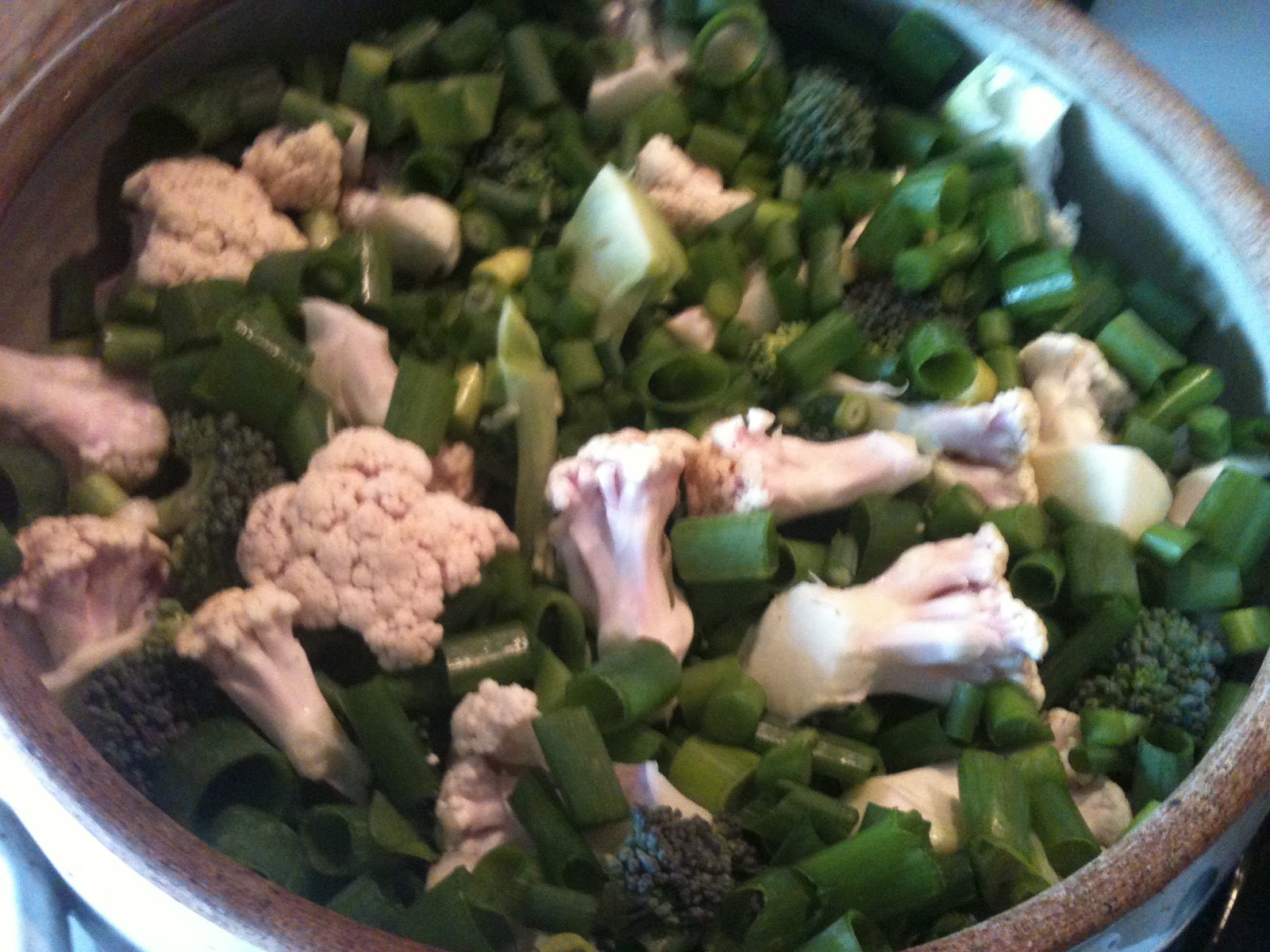
As a result of this, my cooking has been extremely local of late, but I've been having trouble keeping ahead of all of my farming tasks and still retaining enough energy to write a blog post. Today's dinner, however, made me realize that it's good to take a break for something you love, sometimes. And if there is one thing I love, it is Broccoli, Cauliflower & Cheese Casserole.

I've been using different recipes for years, and there are endless variations, but today I was feeling adventurous and decided to try making up the recipe myself. This is more or less what I came up with. I was trying to keep it traditional, but if you know me at all, you know that I would be quick to add some spice to this any time. Curry, paprika, or italian seasonings like basil and oregano come to mind.

This is a recipe that reminds me of my family, and of home.

Sauce:

2 tbsp butter
2 tbsp unbleached flour
1 1/2 cups milk
3/4 cup grated old cheddar cheese
salt and pepper

This is a basic cheese sauce. Make the roux by melting butter in a saucepan, then add the flour and cook, stirring, until brown, about 2 minutes. Add the milk and heat, stirring often, until the sauce thickens. Add cheese and salt & pepper to taste, and remove from heat.

1 cup broccoli
1 cup cauliflower
handful of green onions
handful of green garlic
3/4 cup grated old cheddar cheese
1 cup bread crumbs

Arrange the broccoli and cauliflower evenly in the bottom of a medium sized casserole dish. Sprinkle the green onions and garlic on top. Pour the cheese sauce over the veggies, then cover evenly with cheese, and top with bread crumbs. Bake at 350° F for about 30 minutes or until cauliflower is cooked but still firm (broccoli cooks faster and will be done first).

Saturday, May 12, 2012

Looking Up

HighLand Farm. Photo by a previous intern.
Today an old friend and I were walking through a pasture in the late morning, talking about our lives. We had just hiked a big hill at the back of the farm I am staying on-- a hill that leads down to a tidal river that leads out to the sea. By the time we reached the top of the hill we were pretty tired... we were hunched over, looking at our feet, trudging, and looking forward to when the walking would get a bit easier.

Once we crested the hill, I was able to focus more on the beauty of our surroundings. I love the way that the new leaves bring a green glow to the treetops in spring. I love the wind playing in my hair, the smell of springtime in the air, and the fact that I got to enjoy the day with one of my oldest friends in the world. I looked at those beautiful trees and exclaimed, "I just love that wash of green that you see in the tops of the trees this time of year!"

Tulip. HighLand Farm, Photo by Sarah Ferguson.
She knew exactly what I meant. It's like how I'm always telling people that turning on the tap and getting hot water is actually a crazy miracle. And how fascinating those little things that we take for granted can actually be. My friend frames these beautiful things with her camera, or crafts them with her hands, or learns everything about them so that she can hold them and their immaculate beauty in her mind forever. We can easily reflect on all of the wonder that life holds. We both understand that. It's important to us.

I've been thinking about it a lot lately: all of the beauty that life holds. I thought about it this morning when the sun shone in my window at dawn, and I think about it when I'm planting beautiful, healthy, delicious food every day. I thought about it today when asked who my best friends were. I could list them on one hand, starting with my sisters. And thought about it when I bought a book at the used book store this afternoon and started reading it, only to get distracted by an email from a friend who had purchased the exact same book today, and was writing to tell me about it. Amazingly, a major topic of this book is that coincidences aren't really coincidence at all. They are synchronicities. This Universe is full of them. It's lovely.

Me, Charlie and Scott, on HighLand Farm.
Photo by Sarah Ferguson.
My sister, and my friends, and my host here on the farm, we've all discussed it and we agree: there is so much beauty all around us. All we have to do is look up and see it. The people you meet or reconnect with have a purpose for you. They can show you something you didn't see. The friend who calls just when you were thinking about them has a message. You should listen. The song you haven't heard in years, the smell of lilacs in June, the question you asked in your head that got answered secondhand via your sister by an old teacher you haven't seen in years, and the guess you made that turned out to be true: it's all part of the miracle. You just have to look for it.

Grashopper in an onion blossom. HighLand Farm.
Photo by Sarah Ferguson.
Look up. See what's happening around you. Drop what you are doing. Stop thinking about your car, your mortgage, your drama, your job, your regrets. Stop worrying what people think about you. Stop hating what you can't change about them. Just stop. Change the way you think. Next time you have a choice, choose joy. Choose appreciation. Cut someone some slack. Accept that they are who they are, just as you are who you are, and that there is inherent beauty in it just the way it is. Allow your friends and family to have flaws, and believe that those flaws can teach you something valuable. Accept that you are right where you need to be doing exactly what you need to do.

Look up at the sun or the moon or the sky, and see infinity. This is what you are. We are part of the infinite wilderness, and it is infinite inside of us, and we can't change it or control it. We can only accept it and play our little part. And that's beautiful.

Your life will have its hills, and whether you like it or not, you will have to climb them. You can look down at your feet and be resigned to your fate, or you can look up and see the beauty of the journey. To me, the choice is simple. I hope you find yourself looking up too. 

Friday, April 13, 2012

The Real Food Diet

Okay, so I have become a little distracted from my "concoctions" posts. But they aren't cancelled, just delayed... and for good reason.

Reason the first? I moved to an organic veggie farm in Nova Scotia! Reason the second? Because I realized that it will probably make more sense to make yogurt from a goat I milked myself, fermented veggies from veggies I grew myself, and do a blog about a sourdough experiment that actually worked.

In case you haven't guessed, the farm I am on has goats for milking. The kids are really cute, and there are more soon to come-- one momma is about to pop! So I plan to make yogurt from some of the milk, because according to some of the reading I have been doing recently, raw milk products are incredibly good for you: way better than pasteurized. Additionally, some of the most important nutrients that we can get from food are found in animal fats and products like eggs and butter that come from animals who live more like they would in nature. So, chickens and ducks should be allowed to forage and eat bugs and worms, and goats and cows should graze and eat grass like they were meant to do. This allows them to create the most nutritious milk, eggs, and meat. There are nutrients in these foods in the correct ratios that can't be found anywhere else (e.g. Omega 3 fatty acids), and when left raw, these foods also include all of the necessary digestive enzymes that allow you to digest the food properly and completely.

But don't get me wrong: I still looooove my veggies! That's why eating locally matters so much. Vegetables that are in season, fresh, and grown organically using sustainable methods are so much better for you. Mass-produced food is grown using methods that only serve to make the vegetables look pretty and keep fresh for long periods of time (so they can be trucked to a far-away supermarket). Organic veggies grown in small-scale operations are grown using methods that feed not just the plants themselves, but the soil's ecosystem, which produces healthier, more nutritionally complete food.

The point here is that the healthiest way to eat is to eat whole foods. Real foods. Not foods that require an ingredients list a mile long, or that include words we can't pronounce.

According to the same author, the true evil of the modern diet, and the thing that causes most modern ailments such as heart disease, auto-immune issues, cancers, and degenerative illness like Alzheimers is actually sugar. Go figure.

This is a mind blowing revelation for me, but it is one that really makes sense. After all, humanity survived for thousands of years living on these animal products, without sugar. And it is only since we have started to eat it at every meal, and with almost every food or drink, that we have noticed the prevalence of all of these diseases.

Of course, as with anything, I think it is important to take this information with a grain of salt (not sugar!). Obviously, a little bit of sugar once in a while isn't going to kill us. But the less sugar we eat, the better. So, in addition to trying as hard as I can to eat only real foods that are, wherever possible, produced on the farm, close to home, or a the very least, organically, I am also going to try to greatly reduce my intake of sugars and refined carbohydrates (refined carbs turn to sugar once they are digested). In other words, I'm focusing on real food.

So far, I feel great, but that might also be attributable to the fact that I have been spending every day doing physical work, outdoors, in the fresh air. I'll keep you posted on the results, though. And more to come soon on my other farming adventures :)

---

If you're interested in more information on the specific reading I have been doing, check out the Weston A. Price Foundation, as well as the campaign for real milk. The Real Food Diet is a real thing, too, apparently... according to Oprah, anyway.